
A patient may be a good candidate for gynecomastia surgery if they experience:
A medical consultation helps determine whether surgery is the most appropriate treatment.

Gynecomastia surgery is a procedure designed to remove enlarged breast gland tissue and reshape the chest to create a flatter, more masculine contour.
The procedure typically includes:
Gynecomastia surgery in Kuwait is usually performed under general anesthesia and typically takes 30 to 60 minutes.
The surgeon removes the enlarged gland through a small incision around the edge of the nipple. Liposuction may also be used to sculpt the chest and improve contour.
Most patients are able to return home the same day after the procedure.
After gynecomastia surgery, patients usually notice:
Results are generally long-lasting, especially when patients maintain a stable weight.
In most cases, gynecomastia does not return because the enlarged gland is removed during surgery.
However, recurrence may occur in rare situations such as:
Recovery after gynecomastia surgery is usually relatively quick.

The surgical incision is typically placed around the edge of the nipple, which helps conceal the scar.
Over time the scar usually becomes:
The cost of gynecomastia surgery in Kuwait depends on several factors such as:
The best way to determine the exact cost is through a consultation and evaluation.
Male chest contouring requires precise surgical judgment. Over-resection, under-resection, contour irregularities, asymmetry, and unnatural chest appearance may occur when surgical planning is not individualized.
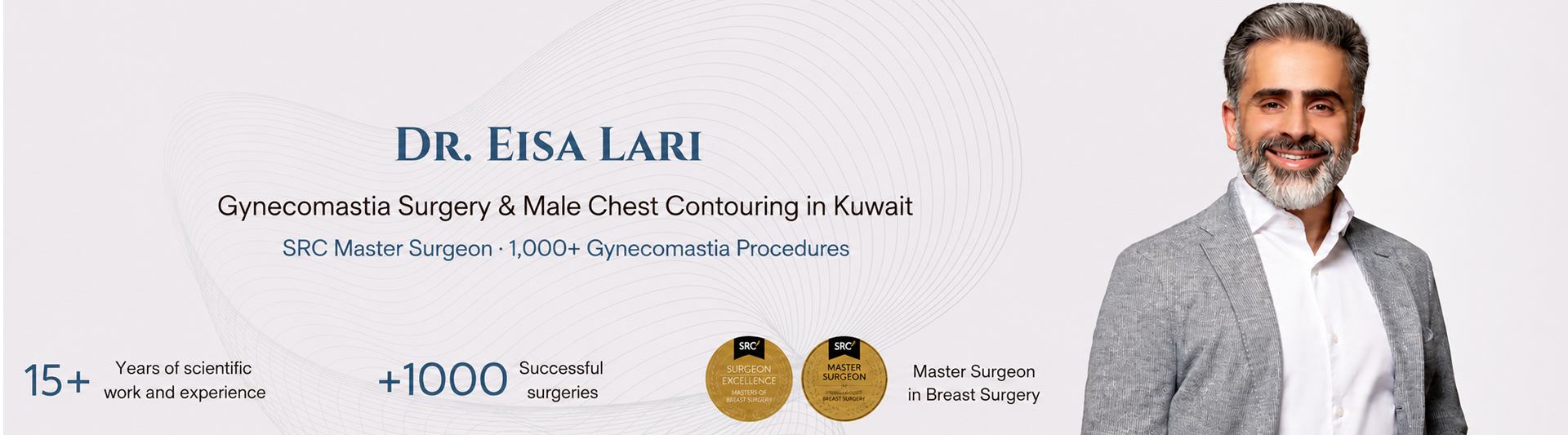
Dr. Eisa Lari has performed over 1,000 gynecomastia procedures using a highly standardized approach focused specifically on male chest aesthetics.
The goal is not simply a flatter chest, but a natural masculine contour that fits the patient’s body structure.
Dr. Eisa Lari is known for treating gynecomastia and male chest contouring in Kuwait.
He has extensive experience in gynecomastia surgery and maintains one of the largest libraries of before-and-after gynecomastia cases in the region due to the high number of patients treated.
Dr. Lari is also involved in scientific research related to gynecomastia surgery and breast procedures and holds advanced professional recognitions such as:

To help you feel confident and informed, here are answers to some of the most common questions we receive about gynecomastia and male breast reduction surgery.
In many cases, incisions are placed near the edge of the areola to help minimize visibility. Scar appearance depends on healing characteristics, surgical technique, skin quality, and the severity of gynecomastia. Patients with larger grades of gynecomastia or excess skin may require additional skin reduction procedures.
Many patients with gynecomastia have firm gland tissue beneath the nipple area that cannot be removed through exercise alone. In these cases, direct gland excision is often necessary to achieve a flatter and more natural masculine chest contour.
Recurrence after surgery is uncommon but may occur in certain situations, including significant hormonal changes, weight gain, medication use, or continued anabolic steroid use. Maintaining a stable weight and healthy lifestyle may help reduce recurrence risk.
Most patients return to office-based work within several days after surgery. Swelling and tightness gradually improve over several weeks and months, with chest contour becoming more defined over time.
Light walking is encouraged early after surgery. More intense exercise and chest training are usually delayed for several weeks depending on healing, swelling, and recovery progress.
Athletes and bodybuilders often require a more specialized surgical approach due to low body fat, chest muscle definition, and skin quality. Surgical planning must account for natural masculine contour, symmetry, and avoidance of contour irregularities in lean patients.
Over-resection may create contour irregularities, asymmetry, or an unnatural chest appearance, particularly in lean or athletic patients. Careful surgical planning is important to preserve a natural masculine contour while adequately reducing gland tissue.
If you are experiencing chest enlargement or believe you may have gynecomastia, a medical consultation can help determine the cause and identify the most appropriate treatment.